LOADING BREAKS...
← Back to Artists
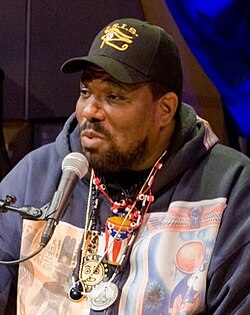

ElectroHip-HopBreakbeatElectro-FunkOld School Hip-HopUSAearly-1980s-present
Afrika Bambaataa & The Soulsonic Force occupy a foundational place in the meeting point between early hip-hop, electro and breakbeat culture. Emerging from the Bronx in the first wave of hip-hop, the project became one of the clearest examples of how DJ culture, MC performance and machine-driven futurism could be fused into a new language for clubs, radio and the street.
At the center was Afrika Bambaataa, born Kevin Donovan, a key South Bronx figure whose importance extends beyond records alone. Before the group's best-known releases, he had already become widely associated with the formative ecology of block parties, competitive DJing and the wider cultural framework that helped define hip-hop in New York.
Bambaataa is regularly cited alongside other first-generation architects of breakbeat DJing. His sets were known for their breadth, drawing from funk, soul, rock, electronic records and imported sounds in ways that widened the vocabulary of early hip-hop. That open-eared approach would become crucial to the music later released under the Soulsonic Force name.
The Soulsonic Force gave that DJ vision a recorded form. Rather than simply documenting party rap, the group helped redirect hip-hop toward a more synthetic, rhythm-machine-led sound. In that shift, they became central to the emergence of electro as a durable style rather than a passing studio experiment.
Their defining breakthrough was "Planet Rock," produced with Arthur Baker and shaped in part by the electronic influence of Kraftwerk. The record's combination of rap cadences, drum-machine pressure and European synth motifs was a decisive moment in club music history. It connected Bronx hip-hop to a broader transatlantic electronic imagination and became a reference point far beyond rap.
For breakbeat history, "Planet Rock" matters not only as a hit record but as a structural template. Its hard, stripped rhythmic programming and futuristic atmosphere fed directly into electro, freestyle, Miami bass and later strains of breakbeat-oriented dance music. It is one of the records most often invoked when tracing the lineage from early hip-hop to rave-era machine funk.
The follow-up body of work reinforced that direction. Tracks such as "Looking for the Perfect Beat," "Renegades of Funk" and "Unity" helped establish the group as more than a one-record phenomenon. Across those releases, the balance between MC chants, electronic sequencing and club functionality remained central.
The project also reflected the collective dimension of early hip-hop. The Soulsonic Force name foregrounded a crew identity rather than a purely individual star vehicle, and that mattered in the context of the period. Hip-hop's first recorded era was built through DJs, MCs, dancers, crews, sound systems and local networks, and the group carried that social structure into the studio.
Bambaataa's wider role through the Universal Zulu Nation further amplified the group's cultural reach. Even when discussions move beyond discography, his orbit is tied to the circulation of hip-hop as a social movement and to the spread of its values and aesthetics across scenes outside New York.
As electro traveled internationally, Afrika Bambaataa & The Soulsonic Force became touchstones for dancers, DJs and producers in Europe, the United States and beyond. Their records were absorbed into b-boy culture, club culture and later electronic dance scenes, where the mechanical swing and stripped funk of the productions remained highly usable.
In the specific history of breakbeat culture, their legacy is unusually deep. Producers working in electro breaks, hardcore, bass music and related hybrid forms repeatedly returned to the rhythmic logic first crystallized in these recordings. The group's work helped prove that break-driven dance music could be futuristic without losing its street function.
Any historical account also has to note that Bambaataa's public legacy has become heavily contested by serious allegations that emerged later in his life. Those allegations have significantly affected how his place in culture is discussed. Even so, the recordings made under Afrika Bambaataa & The Soulsonic Force remain central documents in the history of electro, early hip-hop and the wider genealogy of breakbeat music.
ESSENTIAL TRACKS
Planet Rock
Looking for the Perfect Beat
Renegades of Funk
Unity
KEY RELEASES
Planet Rock (1982)
Seminal electro single
Looking for the Perfect Beat (1983)
Key early electro follow-up
Renegades of Funk (1983)
One of the group's signature recordings
Unity (1984)
Electro-era collaboration associated with the Zulu Nation orbit
RELATED ARTISTS
