
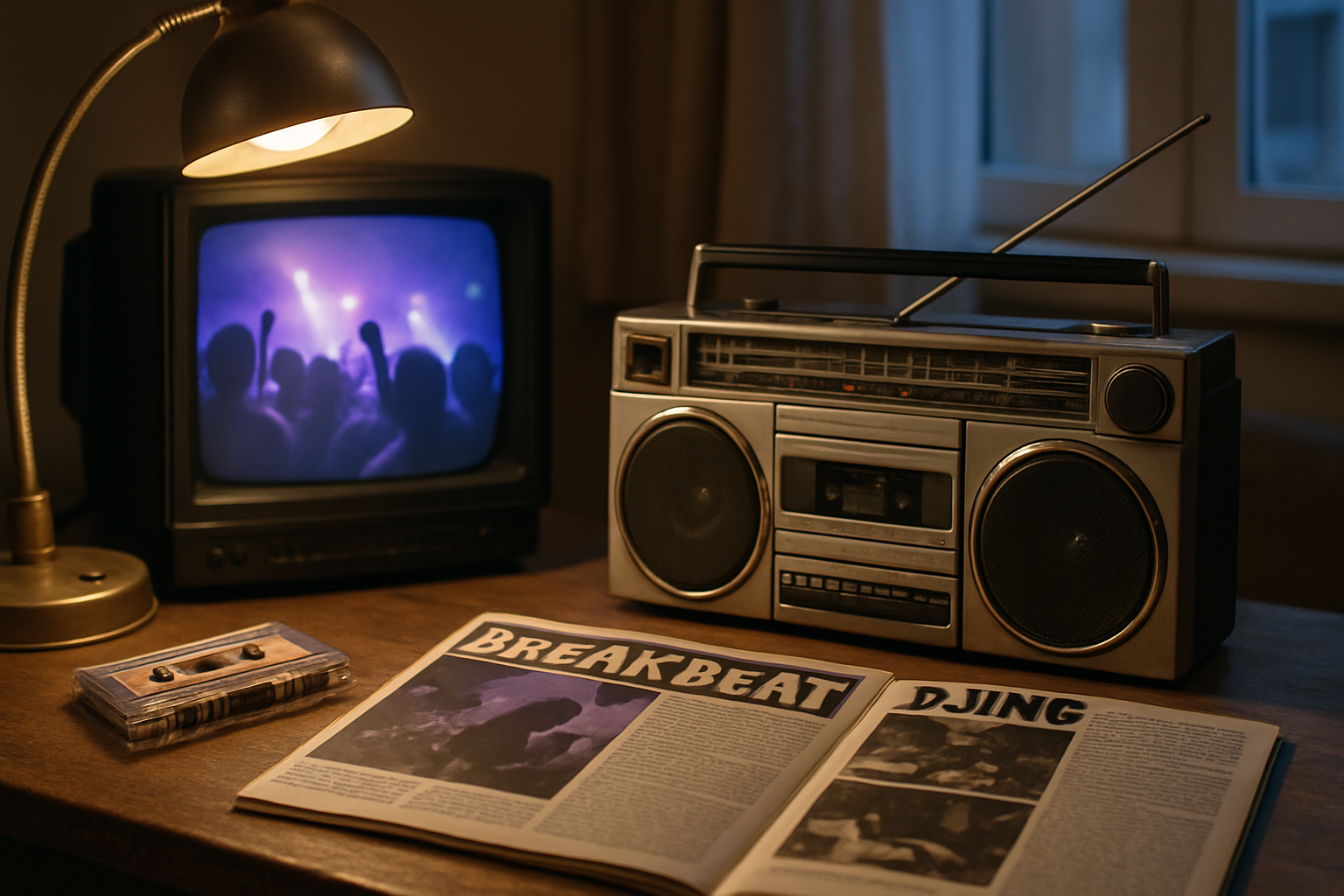
Breakbeat is not just “music with broken drums.” It’s a way of understanding rhythm that spans decades of club culture, from the Bronx to the British rave scene, and from there to local scenes with their own identity — including Andalusia, where breaks stopped being just an influence and became a language.
In this guide, you will understand what breakbeat is, where the concept of the “break” comes from, how it turned into a universe of subgenres (hardcore, jungle, big beat, nu skool, etc.), and why today breakbeat is once again a central creative tool in electronic music.
If you want to open tabs while you read, the History archive at Optimal Breaks expands each stage with chronology, artists, and context.
What is Breakbeat (a clear definition, no fluff)
Breakbeat is an umbrella term for music — mainly electronic and dancefloor-oriented — built on drum breaks (rhythmic fragments, often taken from funk, soul, jazz, or R&B recordings) that are looped, chopped, rearranged, and processed to create syncopated grooves.
Unlike the straight 4/4 pulse (kick on every beat) typical of house or techno, breakbeat tends to:
- use syncopations and displaced accents (with a “shuffle” or “rolling” feel)
- play with ghost notes, fills, silences, and micro-cuts
- generate a more “human” movement, closer to a live drummer’s feel
And here’s the key: breakbeat is not a single closed genre, but a family of styles sharing the idea of the “break” as the rhythmic engine.
For a general definition and broad use of the term, a useful reference is the Wikipedia entry on Breakbeat (as an overview, not as gospel):
- https://en.wikipedia.org/wiki/Breakbeat
What does “break” mean (and why it’s at the heart of everything)
In recorded music — especially funk and soul — the break is usually a moment where the arrangement “opens up” and the drums become more exposed (or directly solo). Those seconds became gold for DJs, b-boys, MCs, and later, producers.
The Amen Break: the most famous (and most controversial) loop The iconic example is the Amen break, a seven-second segment from “Amen, Brother” (1969) by The Winstons, played by Gregory Coleman. It has been sampled thousands of times and is central in hip hop, jungle, and drum & bass.
Reference:
- https://en.wikipedia.org/wiki/Amen_break
This case also opens up an important topic: the history of breakbeat is threaded with debates on sampling, rights, attribution, and cultural economics. The rhythm travels, but the benefits do not always travel with it.
Roots: from the Bronx and early hip hop to the idea of the “infinite loop”
Although today we talk about breakbeat as an electronic language, its modern history takes off in the DJ culture of the Bronx in the 70s.
Kool Herc, Flash, and the “break” as a technique DJ Kool Herc popularized the idea of extending breaks so dancers (breakers) would have more time. Grandmaster Flash perfected techniques to return to the start of the break with precision. That logic — repeating the break — is breakbeat’s DNA: isolate the rhythm, expand it, and turn it into a base.
It is no coincidence that breakbeat has been, from the start, a culture of:
- DJing (control of time and groove)
- editing (cutting and repeating)
- dancefloor (the rhythm’s social function)
If you’re interested in this starting point, at Optimal Breaks we connect it with later scenes in History and profiles in Artists.
From tool to genre: the UK rave explosion (late 80s / early 90s)
The big leap came when the British scene mixed acid house, hip hop, reggae sound system culture, and rave spirit. In that melting pot, breakbeat stopped being just a resource and became an aesthetic in its own right.
Breakbeat hardcore: the turning point In the early 90s, breakbeat hardcore (also called oldskool hardcore) crystallized, mixing:
- rave pianos
- stabs
- sub-bass
- sped-up and sampled breaks
From there, lines splintered that would mark the decade: jungle, drum & bass, happy hardcore, darkcore…
Panoramic reference:
- https://en.wikipedia.org/wiki/Breakbeat_hardcore
This period is fundamental because it sets two ideas: 1. the break can be fast and complex (almost orchestral percussion through cuts) 2. breakbeat can sustain a culture (events, pirate radios, white labels, scene tribalism)
To expand on rave context and genealogies, we will develop it in the Events and Labels archives.
Key subgenres: understanding “breakbeat” without confusing everything
The term is used differently depending on era and place. To avoid getting lost, it’s helpful to distinguish some main branches:
1) Jungle / Drum & Bass: breakbeat taken to the limit
Born from the acceleration and extreme reprogramming of breaks (including the Amen), plus reggae/dub influence, focusing strongly on bass and rhythmic engineering. Although today considered separate genres, they are direct offspring of the breakbeat ecosystem.
2) Big beat: heavy breaks, riffs, and mainstream culture (1995–1999)
Big beat makes the break more “rockstar”: big drums, compressed breaks, heavy loops, drops, stadium attitude. Associated names: The Prodigy, The Chemical Brothers, Fatboy Slim (with nuances among them).
Reference:
- https://en.wikipedia.org/wiki/Big_beat
Big beat helped the general public identify “breaks” as something energetic and accessible, although many more underground scenes see it as a distinct branch.
3) Nu skool breaks: club-focused revival of late 90s and 2000s
Between 1998 and 2002, what was called nu skool breaks crystallized: cleaner production, bass in the spotlight, influences from electro, garage, and D&B, with a strong club focus. It is key to understanding “modern” breakbeat in many countries.
Reference:
- https://en.wikipedia.org/wiki/Nuskoolbreaks
Labels and circuits of that era (like Botchit & Scarper, TCR, Marine Parade or Finger Lickin’ in the nu skool imagination) built a scene with DJs, compilations, and dedicated nights. At Optimal Breaks, this stage fits especially well in Mixes and Labels, where the sound is understood through listening.
4) Florida breaks: identity with a US character
Funkier, with more “swing,” with a tradition of DJs and club culture in Florida during the 90s. Sometimes underappreciated in UK-centric stories, but essential on the global breaks map.
What breakbeat sounds like (musical elements that define it)
Beyond labels, there are traits that often repeat:
- Broken rhythm: it’s not chaos; it’s a different grid. The snare can land “late” or “early.”
- Groove and swing: even at high tempos, breakbeat aims for a bodily feeling.
- Bass as glue: from sub lines to acid riffs, the bass organizes movement.
- Sampling and collage: vocals, hits, breaks, scratches, funk cuts, movie clips… (depending on the era).
- Sound design: from the lo-fi crunch of old samples to digital punch with modern compression.
Approximate tempos (not dogma)
- Big beat: ~100–140 BPM
- Nu skool breaks / club breaks: ~125–140 BPM
- Breakbeat hardcore / early jungle: faster (and variable by year/scene)
- D&B: typically at higher ranges (a whole other world)
Technological evolution: from vinyl and samplers to DAWs (and the return to the “human” break)
Breakbeat changes with every available tool:
1. Turntablism and dual decks: manually extending breaks. 2. Samplers (MPC, Akai, etc.): cutting, reassigning, making “chops.” 3. Jungle era: micro-editing, timestretching, surgical rearrangement. 4. DAWs: cleanup, punch, sidechain, synthesis, infinite resampling. 5. Today: coexistence of lo-fi aesthetics (raw breaks) with hyperproduction.
What’s interesting is that, in the 2020s, much electronic music seeks:
- controlled imperfection
- texture
- drums with narrative
and here breakbeat is again a central language.
Breakbeat in Spain and Andalusia: when breakbeat became territory
Telling the story of “breakbeat” only through the UK/USA map leaves out an essential part: how some local scenes adopt, deform, and turn it into identity.
In Spain, breakbeat finds different strongholds depending on city and era, but Andalusia deserves a special mention for one reason: breakbeat was not just an imported style, but a club and community phenomenon, with resident DJs, nights, faithful crowds, and a recognizable sound for those who danced it.
Without oversimplifying (since Andalusia is not a block and each province tells its own story), constants appear again and again in scene memory:
- a taste for hard-hitting, danceable breaks
- long mixes, very physical DJ approach
- connection with local club culture and venue circuits
At Optimal Breaks, this part lives better as an archive than as myth: so it makes sense to explore it from Scenes, crossing it with Artists and sets in Mixes.
Breakbeat vs. techno/house/D&B: differences that really matter
Breakbeat vs House
- House: stable 4/4 pattern, “hypnosis” through repetition.
- Breakbeat: syncopated groove, feeling of lateral push, more emphasis on rhythmic editing.
Breakbeat vs Techno
- Techno: focus on machines, repetition, timbre, and gradual evolution.
- Breakbeat: focus on cut drums, “chops,” dynamics, often narrative through sections.
Breakbeat vs Drum & Bass
- Share DNA (breaks), but:
- D&B: higher tempos and its own grammar (sub bass, drops, structure, mixing).
- Club breakbeat: usually slower and with a different sense of space for the groove.
How to start listening to breakbeat (without getting lost)
If you’re new, a useful route isn’t “best tracks,” but sound families:
1. Oldskool / hardcore: to understand the rave mutation. 2. Jungle / D&B: to hear the break as architecture. 3. Big beat: to feel the break in bombastic mode. 4. Nu skool / modern breaks: to place the 2000s club sound and its legacy. 5. Local scenes: to see what happens when the genre puts down roots.
To make it easy, you can jump straight to the Mixes section of Optimal Breaks and navigate eras in DJ set format, which is how this music truly makes sense: in continuity.
Conclusion: breakbeat is not a label, it’s a method (and a culture)
Breakbeat is cut-up rhythm, yes, but above all it is a way of building dance music from the drums, of thinking like a DJ, of editing like a producer, and belonging to a particular dancefloor at a particular moment.
Its roots are in funk, the Bronx, and hip hop; its expansion, in the British rave; its diversification, in subgenres like jungle, big beat, or nu skool; and its persistence, in scenes that have cared for it as a language — including Andalusia, with its own club memory.
If you want to keep pulling the thread, the natural step is to move from “what it is” to “who and where”: explore the chronology in History, dive into Artists and Labels, and return to breakbeat the way you always do: through a good set in Mixes.