
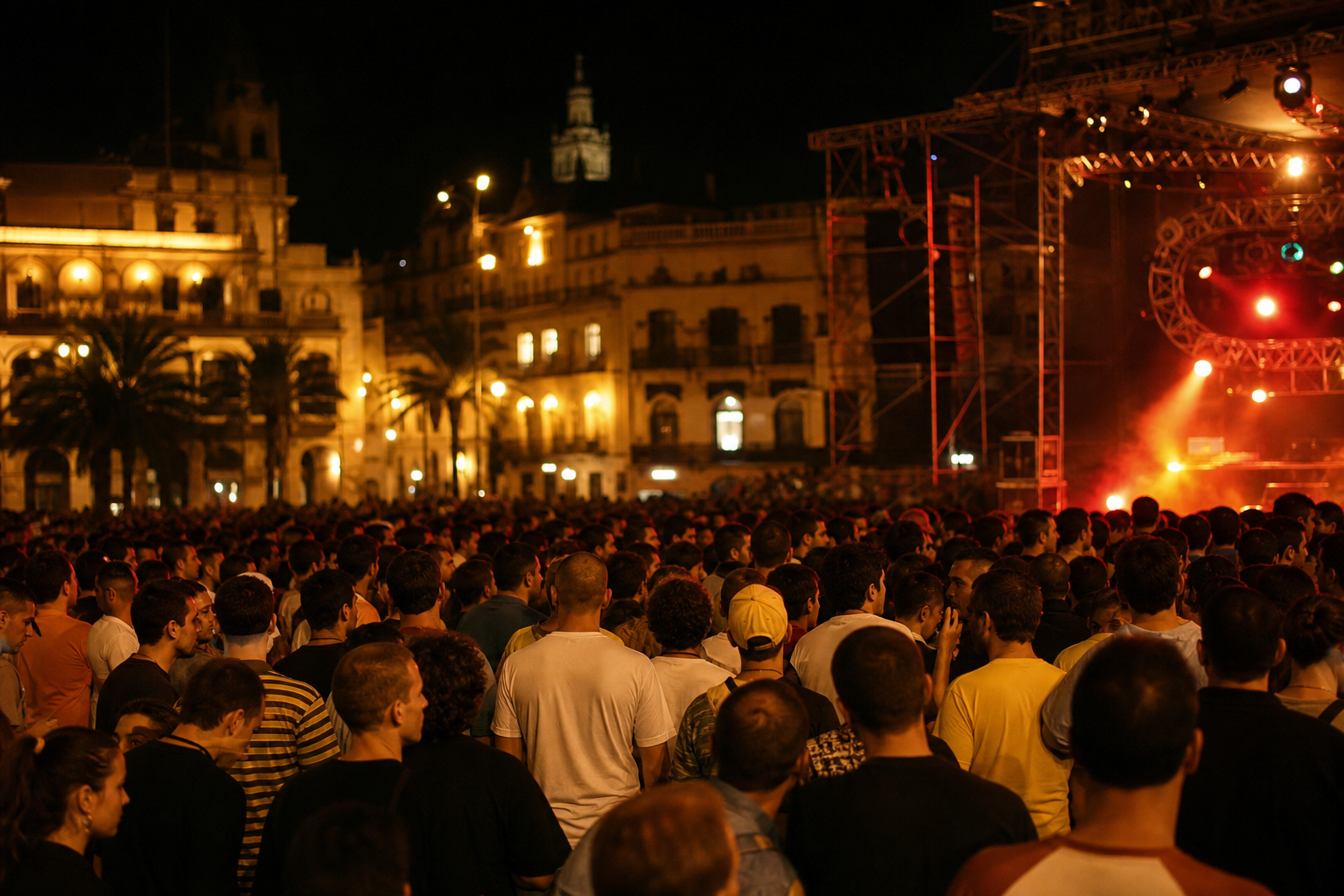
Where breakbeat found its place
The Andalusian breakbeat scene occupies an exceptional place within the history of European electronic music. What remained a relatively specific current within club culture in other territories became a broad social phenomenon in Andalusia, with its own identity, recognizable geography, very loyal audiences, and a cultural footprint that clearly overflowed the framework of a simple specialized scene.
Its uniqueness is not only explained by the popularity it achieved but also by the way it was assimilated and transformed. Andalusia did not receive breakbeat as a passing trend or as a cultural import reproduced without nuances. It turned it into its own language: a particular way of understanding the dancefloor, the night, the movement between provinces, and the relationship between DJs, promoters, and the audience. Therefore, Andalusian breakbeat should not be understood solely as a regional variant within the history of the genre, but as one of the most intense, popular, and distinctive mutations of the entire European breakbeat culture.
The important correction is this: 1992-2002 describes the classical age, not the complete life of the scene. Compared to other territories, Andalusia is precisely one of the places where the continuity of breakbeat has been least disrupted. In the United Kingdom, the United States, or Australia, there were crucial scenes, but the loss of centrality was more visible in many circuits. In Andalusia, on the other hand, breakbeat transitioned from youth and radio hegemony to a culture of continuity: less central in the mainstream but sustained by artists, labels, festivals, collective memory, and new generations.
Origins
The origins of Andalusian breakbeat are usually placed in the early nineties, in the context of the expansion of rave culture and the circulation of British sounds through southern Europe. Andalusia was then undergoing a period of transformation, with greater connections between provinces, an expanding nightlife, and a youth increasingly exposed to new forms of dance music. In this fertile ground, broken rhythms, bass pressure, and the energy of breakbeat found a particularly receptive space.
However, what was decisive was not simply the arrival of a new sound. What was decisive was the speed with which that sound was reinterpreted from local codes. Breakbeat did not implant itself in Andalusia as an exact replica of the British tradition, but as a living matter, adaptable to a very specific sensitivity: more physical, more expansive, more oriented towards immediate connection with the dancefloor and the collective sense of the party. This early appropriation was one of the keys that explain the subsequent development of the scene.
When 1992 is referred to as a symbolic starting date, it should not be understood merely as a chronological reference. It marks the beginning of a broader cultural process: the moment when Andalusia begins to turn an international language into its own tradition. This periodization appears in retrospective accounts and in the documentary Break Nation, which takes the 1992-2002 arc as the axis of historical reconstruction. But the very documentary interest in that period confirms something broader: that cycle left behind a community, a memory, and a network of names that continued to work afterward.
From imported sound to local identity
What truly makes the Andalusian scene unique is that breakbeat ceased to function as an imported sound and became a sign of identity. This process did not happen suddenly, but through a continuous accumulation of parties, sessions, movements, tapes, radios, posters, and reputations built night after night. Gradually, the audience stopped perceiving breakbeat as something that came from outside and began to feel it as a natural part of their own cultural environment.
In many other places, breakbeat was an important current, but it maintained a relatively minority or specialized profile. In Andalusia, on the other hand, it acquired a popular dimension that is very uncommon for music based on broken rhythms and structures that are not always easy to assimilate for mass audiences. This ability to broaden without ceasing to be recognizable as a scene is one of the great distinguishing features of the Andalusian case.
Therefore, rather than speaking of a simple reception of the genre, it is more appropriate to speak of a true territorialization of breakbeat. Andalusia absorbed it, re-signified it, and turned it into a nightlife culture with its own accent, its own imagery, and an emotional intensity that remains one of its fundamental hallmarks today. In the Optimal Breaks archive, this continuity is clearly visible: names like DJ Karpin, Anuschka, Digital Base, DJ Killer, Javy Groove, Hankook, Cerbero, Bubu, Yo Speed, or Fran Break do not describe a closed memory but a genealogy that spans decades.
Geography of the scene
Any quick synthesis about Andalusian breakbeat usually mentions Seville, Málaga, and Cádiz as main poles, and indeed these cities occupy a central place in the memory and historical construction of the scene. However, limiting the phenomenon to a few urban centers impoverishes its true dimension. The strength of Andalusian breakbeat resided precisely in its ability to articulate a much broader territorial network, woven through constant movements, itinerant audiences, and strong circulation between provinces.
Huelva, Granada, Córdoba, Jerez, the Bay of Cádiz, the Málaga coast, and the metropolitan area of Seville were part of a unique cultural geography. It did not depend solely on a neighborhood, a venue, or a specific capital, but on a set of trajectories, connections, and shared rituals. There was a common knowledge of where things were happening, who was setting the pulse of each moment, and what the reference spaces were. This regional network, decentralized yet cohesive, allowed breakbeat to achieve an unusual social implantation within electronic music.
This territorial breadth helps explain why the memory of the scene remains so strong. It was not an experience lived by a small, closed circle, but by a large and very mobile community spread across different points in Andalusia, which built a collective identity around music, nightlife, and shared movement. In this network, cities did not function as isolated compartments: a DJ could be associated with Córdoba and Madrid, a label with Huelva or Cádiz, a promoter with Seville, and still everything could be read as part of the same southern ecosystem.
Sound language and aesthetics
Although Andalusian breakbeat was never a uniform block or a completely closed style, over time it developed a sound personality that is easily recognizable. Generally speaking, the scene tended to privilege rhythmic impact, the prominence of bass, tension on the dancefloor, physical drive, and direct communication with the audience. It was music made to provoke immediate response, to sustain energy, and to turn mixing into a high-intensity collective experience.
This does not mean it lacked nuances or internal diversity. Like any living musical culture, the Andalusian scene was permeated by different sensibilities, influences, and evolutions. From rave and the more direct breaks, it transitioned to intersections with electro, UK garage, bass music, drum and bass, dubstep, speed bass, and digital formulas designed for Beatport, SoundCloud, and DJ circuits. The common trait was not a unique sound recipe, but an idea of functionality: strong bass, broken rhythm, dancefloor response, and a very physical relationship with the mix.
An essential element of this aesthetic was also the role of the DJ. In Andalusia, the breakbeat DJ did not function solely as a selector or technician but as a cultural figure. The booth was a symbolic center of the scene, a place from which loyalties, identities, and expectations were articulated. This intense relationship between artist and audience was one of the bases of the social cohesion of the movement and one of the reasons why its memory remains so powerful.
Expansion and mass popularity
During the second half of the nineties, Andalusian breakbeat left behind its formative phase and entered a period of full expansion. Promoters, venues, DJs, radios, posters, and audiences contributed to consolidating an ecosystem capable of sustaining a large-scale scene. Breakbeat was no longer an emerging current within the overall electronic scene; it had become one of the great soundtracks of Andalusian nightlife.
Here lies one of the most extraordinary aspects of the phenomenon. In most European contexts, breakbeat was relevant, influential, or even central in certain circuits, but it rarely achieved the degree of social penetration that it had in Andalusia. In southern Spain, the genre managed to enter a much broader dimension, integrating into youth culture in a way that is hard to find in other parallel scenes on the continent.
This explains why its memory is not solely tied to specific tracks, labels, or artists, but to an era's experience. Andalusian breakbeat was not just music that was listened to: it was an environment that was inhabited. It marked weekends, friendships, routes, expectations, and ways of experiencing the night. For an entire generation, breakbeat was less a subgenre than a shared world.
Reference years: 1992-2002
The period between 1992 and 2002 has consolidated as the classical framework for describing the first great golden age of Andalusian breakbeat. This chronology appears in retrospective accounts, documentary works, and musical archive projects, and remains useful for delineating the great cycle of formation, expansion, peak, and first symbolic closure of the scene.
During those years, the main myths were formed: the great nights, the emblematic DJs, the events remembered as generational milestones, the sense of belonging, and the certainty that Andalusia had developed its own way of understanding breakbeat. In retrospect, this period appears as a historical anomaly: the moment when a music born from international circuits became a mass phenomenon with an intensely local identity.
However, this chronology should be understood as a delineation of the classical age, not as an absolute limit to history. It serves to explain the foundational cycle and the great peak, but it is not enough to describe what came afterward. If a scene retains active artists, labels with catalogs, its own festivals, intergenerational audiences, and presence in digital stores for over twenty years, it cannot be described as a dead scene.
2002 as a turning point
The year 2002 often appears as a decisive turning point in the historical memory of the scene. The tragedy of Martín Carpena became associated with the end of the first great cycle of expansion and mass popularity, and since then it has functioned as an inevitable reference in any account of the decline of that stage.
But it is important to be precise: 2002 marks the end of a phase of hegemony and explosive growth, not the complete disappearance of breakbeat culture in Andalusia. What is interrupted then is the dynamic of mass expansion as it had been known during the previous decade. Conditions change, context changes, public perception changes, and the position of the scene within the overall nightlife culture also changes. However, the community does not extinguish.
The recent interview with DJ Karpin in La Voz del Sur summarizes this ambivalence well: for many, "the Carpena incident" marks the moment when breakbeat loses mass radio and public legitimacy; at the same time, Karpin himself recounts how today he is back to spinning for several generations. This contrast is key: a hegemony ends, but not a culture.
After the golden age: persistence, memory, and community
One of the reasons why Andalusian breakbeat deserves a long-range entry is that it managed to survive its own golden age. Many scenes experience a rapid rise, reach a peak of intensity, and are then reduced to nostalgic memory. In Andalusia, something more complex happened. Breakbeat remained alive in artists, loyal audiences, brands, parties, personal archives, digital communities, and an extraordinarily resilient generational memory.
For a long time, this continuity was described mainly through the language of legacy or remember. This description was partially correct but insufficient. Memory here was not a simple contemplation of the past, but an active form of cultural preservation. Thanks to it, aesthetics, repertoires, reputations, and affective bonds that might otherwise have dissolved remained alive.
In this phase, Andalusian breakbeat began to exist simultaneously as memory and as practice. It no longer occupied the absolute center of the Andalusian nightlife ecosystem as in its peak expansion moment, but it continued to be a living tradition, capable of producing community, loyalty, and a sense of belonging. This capacity for permanence is one of the clearest proofs of its historical depth.
Labels, platforms, and digital continuity
The continuity after 2002 is better understood by looking at the labels. Distorsion Records, 13monkeys Records, Sound Perfect Breakz Records, Selecta Breaks Records, N-Mitysound Records, Move It! Records, Hard & Hits, or Guachinche Records are part of a network that kept Andalusian and Spanish breakbeat circulating during the digital era. Some were born or consolidated in the 2000s; others belong to the later wave of bass music, UK garage, electro breaks, and online distribution.
Beatport, Juno Download, SoundCloud, YouTube, Mixcloud, and Bandcamp largely replaced mass radio as visibility infrastructure. This changed the scale of the phenomenon but did not eliminate activity. The scene became more specialized, more connected to digital stores, and more dependent on the DJ circuit, but it continued to produce music. In terms of archiving, this stage is fundamental because it demonstrates that culture did not remain frozen in memory: it adapted to new tools.
The history of labels from Huelva, Cádiz, Seville, or Málaga also shows that Andalusian breakbeat did not depend on a single city or a single generation. Its continuity relied on a flexible network: producers remixing, DJs moving tracks between events, compilations grouping local names, and labels functioning as meeting points for neighboring sounds.
Artists of continuity
The Optimal Breaks catalog itself forces a correction of any reading of death in 2002. More than sixty entries linked to the Andalusian category include eras that reach the present: Aggresivnes, Aldo Ferrari, Ale Baquero, Anita Breakz, Anuschka, Bad Legs, Bamer 29, Bartdon, Belforg, Bowser, Bubble Couple, Bubu, Cerbero, Chewy Martins, Colombo, Coofu, Deibeat, Digital Base, DJ Karpin, DJ Killer, DJ Maribel, DJ Nitro, DJ Pote, Dub Elements, Fran Break, FRANXIS'90, Godino, Guau, Hankook, Javy Groove, Jordi Slate, JottaFrank, Khaine, KULTUR, Manu Twister, MBREAKS, Mutantbreakz, Niño Breaks, Paket, Pavane, Perfect Kombo, Peter Paul, Rasco, Rhades, SeekFlow, Sekret Chadow, Shade K, Signal31, SL Small, Tomy Breaks, Vazteria X, Wardian, Woter, Yinx, or Yo Speed, among others.
This list should not be read as a simple accumulation of names but as structural evidence. If so many profiles span decades, if there are digital releases, and if festivals continue to program classics and current artists, then the scene has historical continuity. Not all continuity is mainstream; sometimes the real history of a genre lives in intermediate layers: residents, small labels, compilations, remixes, local booths, and audiences that do not need validation from mainstream media to continue existing.
Raveart and public reactivation
The activity of Raveart is particularly significant for understanding the present. The organization appears in this site's database as active since 2002, precisely the year often used as a symbolic boundary. This coincidence is revealing: while the public narrative spoke of decline, part of the infrastructure that would support the next stage was beginning to consolidate.
More than two decades later, Raveart articulates much of the contemporary visibility of Andalusian breakbeat: Summer Festival, Winter Festival, Retro Halloween, club cycles, and collaborations with international artists. In 2025, media such as House Andujar and NRF Magazine covered their arrival at Elysium in Seville with their own residency, emphasizing that breakbeat "had never completely faded away" and that after the pandemic, the movement has re-emerged strongly.
The case of Summer Festival 2026, presented by Wololo Sound as an event where breakbeat continues to gather generations, confirms this reading. It is not to say that the present is identical to 1998: it is not. The current scene operates with different means, different audiences, and another ecosystem. But precisely for that reason, it holds historical value that it continues to bring together people, artists, and its own discourse.
Legacy within Spanish and European electronic music
The legacy of Andalusian breakbeat goes far beyond regional nostalgia. Within Spain, it constitutes one of the clearest examples of how an electronic music scene can develop a strong territorial identity without isolating itself from international currents. It demonstrates that the history of electronic music cannot be written solely from major capitals, canonical labels, or usual narratives from central Europe. Some of its most intense episodes occurred in other places, and Andalusia is one of the most evident cases.
On the European breakbeat map, the Andalusian scene stands out not only for its production or its names but for the depth of its social roots. Its historical importance relates to how a genre ceased to be a musical label to become a form of collective life. This intensity of appropriation is what makes it truly exceptional.
That is also why it continues to spark interest in documentaries, mainstream media, radio, and musical archive projects. Andalusian breakbeat is not a local curiosity or a footnote within Spanish electronic music. It is a major case of how an international musical culture can acquire a radically local, massive, and lasting form.
Living heritage and reinterpretation
In recent years, a particularly revealing idea has consolidated: that of Andalusian breakbeat as living heritage. This does not mean turning the scene into a museum piece or fixing it in an immobile past. It means recognizing that it has become part of the way Andalusia understands a part of its own recent cultural history. It is remembered, claimed, reactivated, and narrated as something that fully belongs to the contemporary musical identity of the territory.
This heritage dimension is important because it modifies the way the scene is interpreted. When a musical culture reaches that degree of collective recognition, it stops depending solely on present trends. It also exists as a shared historical reference, emotional archive, and sign of cultural uniqueness. Andalusian breakbeat has clearly reached that status.
But heritage does not equate to immobility. On the contrary: in this case, memory has helped sustain new readings of the past and new forms of public presence. Nostalgia can be a problem if it freezes; here, many times, it has functioned as a transmission mechanism. Parents, children, nephews, veteran DJs, and new audiences share spaces where the sound still makes sense.
Present and the 2020s
Any text about Andalusian breakbeat written today must recognize that the simple narrative of rise, fall, and pure nostalgia is no longer sufficient. In recent years, and especially visible since the post-pandemic recovery, the scene has shown clear signs of renewed vitality, media presence, and capacity to gather people. It is not a return from nothing: it is the renewed visibility of a culture that had remained alive in less visible layers.
The current context is not identical to that of the classical age. The musical, media, and technological ecosystem has changed profoundly. The way music is consumed, circulated through scenes, and built identity is no longer the same as in the nineties or the early 2000s. But precisely for that reason, it is even more valuable that Andalusian breakbeat continues to show the capacity for gathering, recognition, and transmission between generations.
What is most accurate today is not to say that the scene "has returned" as if it had completely disappeared, nor to reduce it to a simple glorious memory. The most accurate assertion is that Andalusian breakbeat is going through a phase in which historical memory, identity continuity, and new public presence combine. This combination makes it a culture that is both inherited and current, heritage and active, mythical and still alive.
A more complete historical model
The most useful way to understand Andalusian breakbeat is not as a linear story of rise and fall, but as a sequence of several phases. The first is that of formation and expansion, from the early nineties, when rave culture, broken rhythms, and Andalusian nightlife converge. The second is that of great peak, when breakbeat reaches mass dimension and becomes one of the most powerful youth expressions in southern Spain.
The third phase is that of persistence: the scene loses media centrality but retains identity through memory, labels, producers, parties, and continued practice. The fourth is that of contemporary reactivation, in which heritage and current relevance reinforce each other again. This model allows for justice to the real complexity of the phenomenon. It recognizes the decisive importance of the classical cycle without enclosing the entire history within it.
Above all, it allows for understanding a fundamental truth: Andalusian breakbeat was not only an irreplaceable historical explosion but also a culture with the capacity for survival, reinterpretation, and renewed presence in the present. If anything demonstrates this, it is that a scene can lose media centrality without losing its cultural thread.
Conclusion
Andalusian breakbeat is one of the clearest examples of how music born in international circuits can become a deeply local cultural form without losing its belonging to a transnational tradition. Born from the rave impulse and reformulated by the geography, sensitivity, and audiences of Andalusia, the genre transformed here into something more than a style: it became a complete scene, a generational memory, and a long-reaching musical identity.
Its classical age between 1992 and 2002 remains the foundational core of its myth and historical relevance. But its story does not end there. The persistence of the legacy, the strength of its collective memory, the activity of labels and producers, and the renewed visibility of recent years demonstrate that Andalusian breakbeat does not belong exclusively to the past. It remains one of the most intense, recognizable, and enduring traditions of the entire European breakbeat culture.
Talking today about Andalusian breakbeat is simultaneously talking about origin, expansion, community, rupture, heritage, and present. Few scenes can claim such a strong mythology, such an extensive memory, and such a clear capacity to continue gathering meaning decades after their first great explosion. Andalusia can.