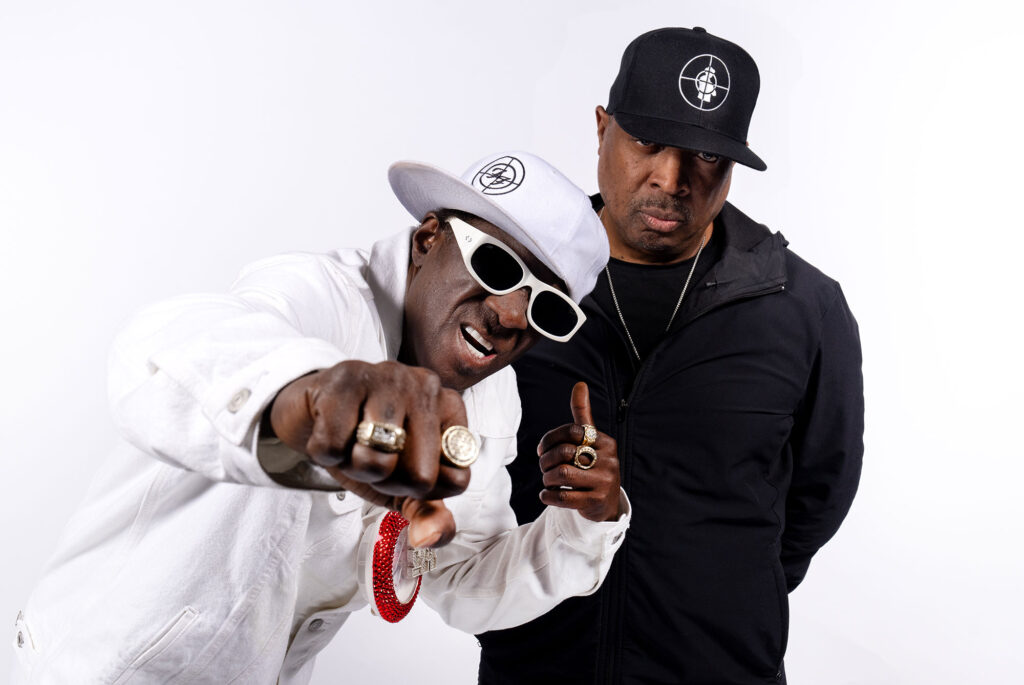

Public Enemy is an American hip-hop group whose work reshaped the political and sonic possibilities of rap in the late 1980s and early 1990s. Although not a breakbeat act in the strict genre sense, their dense sample construction, militant rhythmic drive and DJ-centered architecture made them a crucial reference point for producers across hip-hop, jungle, big beat and breakbeat culture.
The group emerged from Long Island, New York, around the circle that included Chuck D, Flavor Flav and the production team the Bomb Squad. From the start, Public Enemy presented itself as more than a rap group: it functioned as a collective with a strong visual identity, a confrontational public voice and a stage language that drew on street reportage, Black political thought and media critique.
Their early rise was tied to the Def Jam orbit, where they arrived during a period when rap was becoming a national commercial force while still retaining a hard connection to club systems, radio and street circulation. Public Enemy stood apart by making records that sounded urgent, crowded and deliberately abrasive, with layers of sirens, funk fragments, spoken-word pressure and cut-up rhythm.
The debut album Yo! Bum Rush the Show introduced that framework, but it was the next phase that established their historical weight. By the end of the 1980s, Public Enemy had become one of the defining groups of politically charged hip-hop, with Chuck D's commanding delivery, Flavor Flav's disruptive counterpoint and the Bomb Squad's production creating a sound that felt both chaotic and highly organized.
It Takes a Nation of Millions to Hold Us Back is widely regarded as the key breakthrough. The record expanded the possibilities of sample-based production and album sequencing in rap, turning collage into a form of argument. Its impact reached well beyond hip-hop audiences and helped set a template for aggressive, rhythm-heavy music that later resonated with breakbeat and bass producers.
Fear of a Black Planet pushed that method further. The album's compressed, high-density production and explicitly political framing made it one of the central documents of its era. Tracks such as "Fight the Power" became inseparable from the wider cultural conversation around race, media representation and public space in the United States.
Apocalypse 91... The Enemy Strikes Black showed another stage in the group's development, retaining the force of the earlier work while moving through a changing rap landscape. Across this period, Public Enemy's records circulated not only as albums but as DJ tools, remix material and reference points for producers interested in maximal rhythm science.
The group's internal structure changed over time, with figures such as Professor Griff, Terminator X and later DJ Lord associated with different phases of the project, alongside the visible presence of the S1W performance unit. As with many long-running crews, membership and public roles shifted, but the core identity remained strongly tied to Chuck D and Flavor Flav.
Public Enemy's importance to breakbeat-adjacent culture lies partly in method. The Bomb Squad's approach to layering breaks, noise, funk loops and hard edits helped normalize a more fractured and cinematic use of rhythm. That sensibility fed into later sample-heavy dance music, from UK cut-and-paste hardcore and jungle aesthetics to big beat's rock-inflected impact.
They also mattered as a model of how rap could operate as mass communication without softening its edge. Pirate radio, specialist DJs, club selectors and producers in different scenes repeatedly drew from Public Enemy's records, whether through direct sampling, remix logic or the broader lesson that rhythm could carry political intensity without losing physical force.
In the 1990s and beyond, the group continued to release albums and perform internationally, even as the center of mainstream rap shifted. Later work did not erase the scale of the early run, but it confirmed Public Enemy as an enduring institution rather than a short-lived moment.
Their legacy is secure across several histories at once: hip-hop, Black political music, sample-based production and the wider genealogy of break-driven sound. For listeners coming from breakbeat culture, Public Enemy remains essential not because they belong neatly inside the genre, but because they helped define what hard, layered, rhythm-led modern music could do.
