LOADING BREAKS...
← Back to Artists
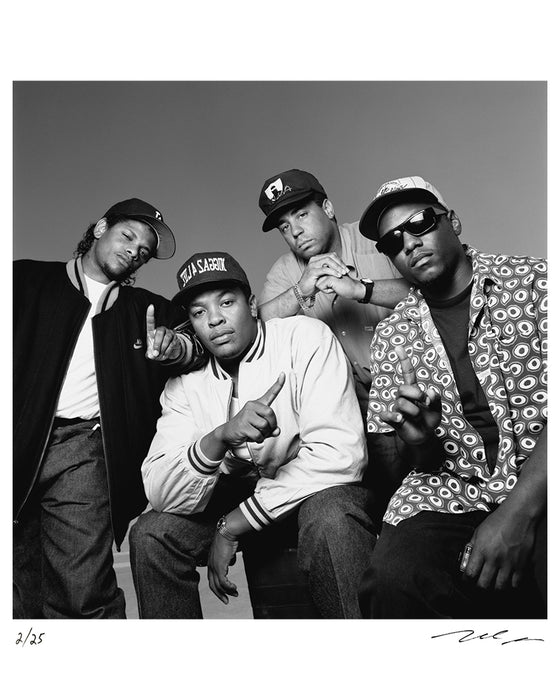

Hip-HopGangsta RapWest Coast RapElectro RapUSAlate-1980s-1990s
N.W.A. was a Compton-based rap group whose impact reached far beyond hip-hop, reshaping the language, politics and sonic identity of late-1980s popular music. Although not a breakbeat act in any strict sense, the group belongs in any wider map of bass-driven urban music because of its production methods, its use of drum-machine pressure and sample collage, and its influence on DJ culture, street radio and later club-oriented forms.
The group emerged in Southern California in 1987, initially orbiting Eazy-E, Dr. Dre, Ice Cube, DJ Yella and Arabian Prince, with MC Ren joining soon after and becoming central to the classic lineup. Their roots connected different strands of Los Angeles black music culture: electro, mobile DJ crews, early rap entrepreneurship and the realities of Compton street life.
Dr. Dre and DJ Yella had already built reputations through the World Class Wreckin' Cru, bringing technical studio knowledge and an ear shaped by electro-funk and club records. That background mattered. Even when N.W.A. became synonymous with gangsta rap, its records still carried the hard machine swing, low-end punch and stripped rhythmic logic inherited from earlier dance-floor forms.
The group's early recordings announced a new level of directness. N.W.A and the Posse served as a formative release, but it was Straight Outta Compton that established the group's historical position. The album fused dense, confrontational writing with forceful, sample-based production and a collective chemistry in which each voice had a distinct role.
Ice Cube's writing was crucial to the group's early identity, giving shape to the sharp reportage, provocation and dark humor that made the records feel both cinematic and immediate. Eazy-E brought a high-pitched, unmistakable delivery that turned menace and irreverence into a signature presence, while MC Ren added technical authority and helped sustain the group after Cube's departure.
Straight Outta Compton became one of the defining documents of West Coast rap. Its sound was lean, aggressive and highly functional: break-derived drum programming, siren-like synth lines, funk samples and arrangements built for maximum impact. The record's language and themes generated controversy, but that controversy was inseparable from its wider cultural force.
Much of the attention centered on 'Fuck tha Police', a track that crystallized the group's antagonistic relationship with institutional power and became one of the most discussed protest records in rap history. N.W.A. did not invent social anger in hip-hop, but they gave it a new scale, a new media visibility and a new commercial reach.
The group recorded primarily in the orbit of Ruthless Records, the label co-founded by Eazy-E and Jerry Heller, and helped define an independent West Coast infrastructure at a moment when regional rap scenes were still fighting for national recognition. Their success showed that Los Angeles rap could set the agenda rather than merely respond to New York.
Internal tensions soon altered the lineup. Arabian Prince left, and Ice Cube departed after disputes over finances and credit, a break that changed the group's chemistry but did not end its momentum. MC Ren became even more prominent, and the remaining members moved toward a heavier, more polished studio sound.
That evolution culminated in Efil4zaggin, released in 1991. The album retained the group's confrontational stance while pushing the production toward a denser and more muscular form of West Coast rap. It stands as the final studio statement of the core N.W.A. era and a bridge toward the solo empires that would follow.
N.W.A.'s afterlife is inseparable from the later careers of its members. Dr. Dre became one of the most influential producers in modern popular music; Ice Cube built a major solo career and a broader media presence; Eazy-E remained a defining figure in West Coast rap until his death; DJ Yella and MC Ren continued to be associated with the group's legacy; Arabian Prince retained an important place in its early history.
Their influence extended well beyond gangsta rap. The group's economy of rhythm, use of funk and electro materials, and emphasis on hard, speaker-driven impact fed into later G-funk, Miami bass crossovers, turntablism culture and many forms of sample-based street music. For listeners coming from breakbeat, jungle or bass traditions, N.W.A. can also be heard as part of a wider continuum of machine rhythm and urban sound-system pressure.
Historically, N.W.A. occupies a foundational place in American rap as a group that changed both content and infrastructure. They made regional specificity central, turned local experience into national argument and helped redefine what a rap group could sound like, say and provoke.
Their catalogue is relatively compact, but its reach has been enormous. More than a nostalgia object, N.W.A. remains a reference point whenever discussions return to censorship, realism, independent rap economies, West Coast production and the relationship between street reportage and mass culture.
ESSENTIAL TRACKS
Straight Outta Compton
Fuck tha Police
Gangsta Gangsta
Express Yourself
100 Miles and Runnin'
Alwayz into Somethin'
Appetite for Destruction
KEY RELEASES
N.W.A and the Posse (1987)
Early compilation-style debut associated with the group's formative period
Straight Outta Compton (1988)
Landmark debut studio album
100 Miles and Runnin' (1990)
EP released after Ice Cube's departure
Efil4zaggin (1991)
Second and final studio album
RELATED ARTISTS
Eazy-E
Dr. Dre
Ice Cube
DJ Yella
MC Ren
Arabian Prince
The D.O.C.
Above the Law