LOADING BREAKS...
← Back to Artists

SoulFunkR&BGospelRhythm and BluesAfro-American MusicUSA1950s-2006
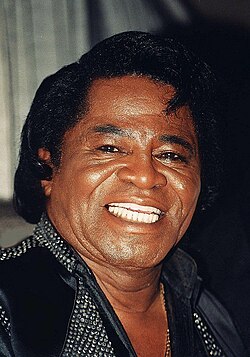
James Brown was an American singer, bandleader, songwriter and producer whose work sits at the root of modern funk and, by extension, a large part of the rhythmic language later absorbed by hip-hop, breakbeat and sample-based dance music. Although he is usually placed within soul and R&B history, his importance reaches far beyond those categories: Brown reorganised popular music around groove, repetition, accent and physical momentum.
Born in South Carolina and raised largely in Georgia, he emerged from the post-war Black American performance circuit that linked gospel, rhythm and blues, touring revues and local club culture. That background mattered. Brown developed not simply as a vocalist but as a total stage leader, shaping bands, dancers, arrangements and audience response with unusual discipline and intensity.
His first major breakthrough came through the Famous Flames, the vocal group with which he moved from regional recognition to national visibility in the 1950s. Early recordings such as "Please, Please, Please" established the emotional directness and dramatic delivery that made him a singular figure in rhythm and blues, while his live reputation quickly became central to his rise.
By the early 1960s, Brown had become one of the defining live performers in American popular music. The success of Live at the Apollo helped confirm that his appeal could not be reduced to studio singles alone. His records captured only part of the picture; the full force of his art depended on band precision, call-and-response dynamics, tightly controlled breakdowns and a sense of performance as ritual.
A decisive shift arrived in the mid-1960s, when Brown began stripping songs down to their rhythmic core. Tracks such as "Papa's Got a Brand New Bag" and "I Got You (I Feel Good)" signalled a new emphasis on interlocking parts rather than conventional song harmony. Guitar, bass, drums and horns were treated as components of a single machine, each part contributing to the pulse.
That approach became even more radical toward the end of the decade and into the 1970s. Brown's records increasingly privileged the "one"—the downbeat—as an organising principle, and his bands turned repetition into propulsion rather than stasis. In practical terms, this was the architecture of funk: concise riffs, clipped horn figures, syncopated bass movement and drum patterns built for bodily response.
The musicians around him were crucial to this development. Brown's groups, including line-ups associated with the J.B.'s, became laboratories for rhythmic innovation, and his role as bandleader was inseparable from the sound itself. He demanded exactness, and that exactness produced records whose internal mechanics would later be studied, replayed and sampled across multiple generations.
Songs such as "Cold Sweat," "Say It Loud – I'm Black and I'm Proud," "Get Up (I Feel Like Being a) Sex Machine" and "The Payback" show different sides of that evolution: from hard, skeletal funk to socially charged statements and extended groove-based constructions. Brown could move between raw dance-floor energy, political address and tightly arranged showband power without losing coherence.
His influence on Black popular music is foundational, but for breakbeat culture his importance is especially concrete. Brown's catalog, and the recordings made by his bands and close associates, became a deep reservoir for drum breaks, horn stabs, vocal shouts and bass fragments. Producers in hip-hop, electro, jungle, big beat and breaks repeatedly returned to this material because it offered both rhythmic force and instantly recognisable physicality.
The famous break from "Funky Drummer," in particular, became one of the most reused rhythmic passages in modern music, but it is only one example within a much wider legacy. Brown's records helped define what a break could do: suspend the song, intensify the groove and create a reusable rhythmic unit. That logic runs directly into DJ culture, loop-based production and the history of sampled dance music.
Beyond sampling, Brown shaped the idea of groove as a compositional centre. Many later forms central to Optimal Breaks' orbit—hip-hop, breakbeat, jungle, UK bass hybrids and funk-inflected club music—inherit something from his insistence that rhythm could carry the full dramatic weight of a track. His work made repetition expressive and made the band function like a sequenced engine long before digital production.
Brown remained a major public figure across several decades, even as his commercial position changed and musical fashions shifted. Later generations often encountered him both as an original artist and as a source text embedded inside newer records. That dual presence is part of why his legacy remains unusually durable: he belongs simultaneously to performance history, recording history and sample history.
He died in 2006, but his place in modern music remains central. For soul and funk he is a defining architect; for hip-hop and breakbeat culture he is one of the deepest rhythmic sources in the archive. Few artists have had such a direct effect on how musicians, DJs and producers understand the relationship between drums, groove and collective movement.
ESSENTIAL TRACKS
Please, Please, Please
Papa's Got a Brand New Bag
I Got You (I Feel Good)
Cold Sweat
Say It Loud – I'm Black and I'm Proud
Funky Drummer
Get Up (I Feel Like Being a) Sex Machine
The Payback
KEY RELEASES
Please, Please, Please (1956)
Debut studio album and early breakthrough period with the Famous Flames
Live at the Apollo (1963)
Landmark live album central to his rise as a major performer
Papa's Got a Brand New Bag (1965)
Key single in the transition toward funk
Cold Sweat (1967)
Often cited as a foundational funk recording
Say It Loud – I'm Black and I'm Proud (1968)
Politically charged anthem from his late-1960s peak
Sex Machine (1970)
Defining groove-based statement of the early 1970s
Funky Drummer (1970)
Source of one of the most sampled drum breaks in modern music
The Payback (1973)
Extended funk classic from his 1970s catalog
RELATED ARTISTS
