LOADING BREAKS...
← Back to Artists
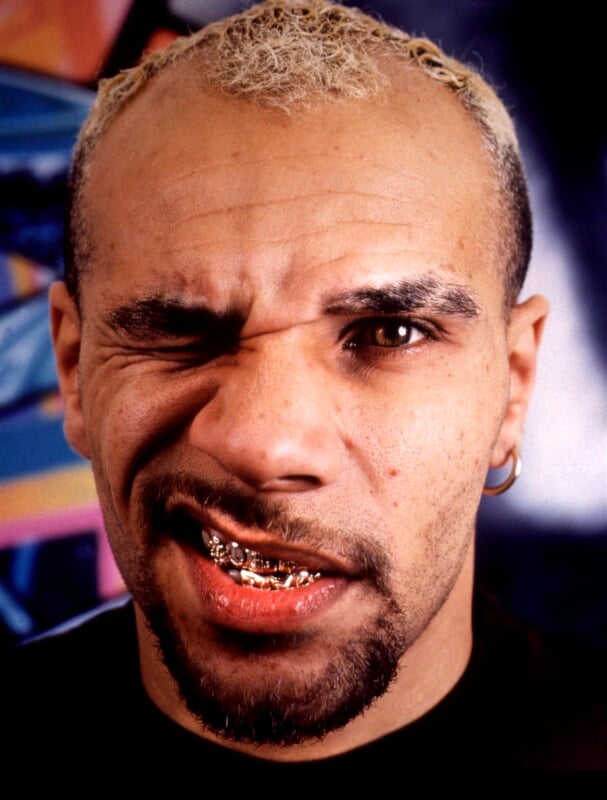

JungleDrum & BassBreakbeat HardcoreTechstepAtmospheric Drum & BassUKearly-1990s-present
Goldie is one of the defining figures in the transition from hardcore rave into jungle and drum & bass. As a producer, DJ, label head and cultural personality, he helped move the music from pirate-radio energy and white-label circulation toward a more expansive album format and a broader public profile.
Born Clifford Joseph Price in England and closely associated with the Midlands and London, he first became known in wider UK youth culture through graffiti before establishing himself in music. That visual background mattered: Goldie approached sound with a strong sense of futurism, urban texture and identity, elements that would become central to his records and to the imagery around jungle in the 1990s.
His earliest musical presence is tied to the formative years of breakbeat hardcore and the networks that fed directly into jungle. He appeared in the orbit of Reinforced Records, the crucial label and production hub associated with 4hero and a more experimental strain of hardcore. Under the Rufige Kru name, Goldie became part of the movement that toughened rave breakbeats into something darker, more pressurised and more distinctly urban.
Those early Rufige Kru releases are important not simply as collector's items but as markers of a changing vocabulary. The drums became more fractured, the bass weight more physical, and the atmosphere more cinematic. Goldie was among the artists who helped define that shift, balancing dancefloor impact with a sense of scale that pointed beyond functional club tracks.
By the mid-1990s he had become one of jungle's most visible figures. His work stood at the meeting point between rough-edged break science, dub-derived low end, sci-fi ambience and a grander compositional ambition than most dance music of the period attempted. That combination made him central to the idea of drum & bass as an album-capable form rather than only a DJ tool.
The key platform for that next phase was Metalheadz, the label and collective he founded. Through Metalheadz, Goldie helped create one of the most influential institutions in drum & bass history. The label became a home for a spectrum of advanced jungle and d&b, and its identity was reinforced by the long-running Sunday sessions at Blue Note in London, a club space that became synonymous with the music's artistic maturation.
Goldie's debut album Timeless remains the pivotal statement in his catalogue and one of the landmark records of 1990s British electronic music. Its long-form structures, orchestral mood, soul inflections and breakbeat propulsion gave jungle a new kind of narrative scale. The title piece in particular became a touchstone for atmospheric drum & bass and for the idea that rave-born music could sustain emotional and compositional depth over album length.
He followed that breakthrough with Saturnz Return, a darker and more imposing work that reflected the harder, more futuristic edge emerging in late-1990s drum & bass. If Timeless opened the music outward, Saturnz Return showed how Goldie could also operate in a more severe, industrial and high-pressure register, in dialogue with the techstep turn of the era.
Across his career, Goldie has worked in close association with artists and producers from the Metalheadz axis and the wider Reinforced lineage. His name is especially linked with figures such as Rob Playford, 4hero, Photek, Doc Scott and Grooverider, not because all of them occupy the same exact stylistic lane, but because they formed part of the same ecosystem that pushed jungle and drum & bass into new technical and aesthetic territory.
As a DJ, Goldie has remained a major ambassador for the culture. His sets and radio presence have often connected different generations of the music, from early jungle foundations to later drum & bass developments. Even when his public profile extended into television, film and mainstream media, his standing within the scene continued to rest on his role in shaping its language and institutions.
His importance also lies in visibility. Goldie was one of the first jungle artists to become recognisable well beyond specialist circles, and that visibility helped carry the music into broader cultural conversation. He did not represent the whole scene on his own, but he became one of its most legible public faces at a moment when jungle was being debated, celebrated and misunderstood in equal measure.
In later decades he has continued to record, DJ and reactivate the Rufige Kru identity, while Metalheadz has remained a reference point for successive waves of drum & bass. His catalogue is not reducible to a single anthem or era: it maps the movement from hardcore mutation to mature drum & bass modernism.
Goldie's historical place is secure. He is not only a successful artist from jungle's first great generation, but a figure who helped define how the music could look, sound and circulate. For any account of breakbeat culture in Britain, he stands as a central architect of its most ambitious and enduring phase.
ESSENTIAL TRACKS
Terminator
Angel
Inner City Life
Timeless
Kemistry
KEY RELEASES
Terminator EP (1992)
Early Rufige Kru release associated with the formative jungle period
Timeless (1995)
Debut album and a landmark in atmospheric drum & bass
Saturnz Return (1998)
Darker, more severe second album aligned with late-1990s d&b futurism
Believe (2004)
Later studio album
The Journey Man (2017)
Return to album format in a later phase of his career
LABELS FOUNDED
Metalheadz
RELATED ARTISTS
