LOADING BREAKS...
← Back to Artists
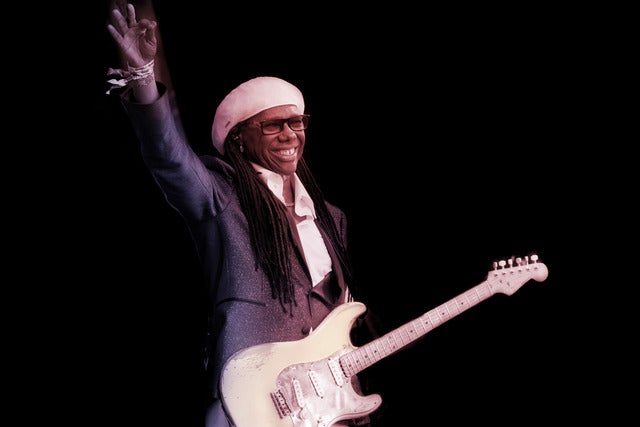

DiscoFunkSoulDanceBoogieUSAlate-1970s-present
Chic is an American group formed in New York and centered on the songwriting, arranging and production partnership of Nile Rodgers and Bernard Edwards. Although they belong first to disco, their records were built with a sharper rhythmic discipline than many of their contemporaries: clipped guitar, elastic bass lines, tight ensemble playing and a studio approach that linked dancefloor immediacy with pop precision.
They emerged in the second half of the 1970s, when New York nightlife, Black dance music, uptown funk and downtown club culture were all feeding into the same ecosystem. Chic helped define that moment, but they also outlasted the narrow idea of disco as a period style. Their records became part of the structural vocabulary of modern dance music, hip-hop and pop production.
From the start, the group was conceived as more than a conventional band. Rodgers and Edwards treated Chic as a complete musical system: songs, grooves, arrangements, visual identity and a broader production language that would also extend into work for other artists. That wider network later became associated with the Chic Organization, under which the pair produced and wrote across late-1970s and early-1980s R&B, disco and pop.
Their debut album Chic introduced the group’s core method with tracks such as "Dance, Dance, Dance (Yowsah, Yowsah, Yowsah)" and "Everybody Dance." These records established the balance that would become their signature: sophisticated but direct, polished but physical, rooted in funk while designed for large sound systems and club play.
The breakthrough phase came quickly. C'est Chic brought "Le Freak," one of the defining dance records of its era, and "I Want Your Love," which showed the group’s ability to combine elegance, melancholy and propulsion without losing pop clarity. Chic’s music was club-functional, but it was never only utilitarian; the arrangements carried a sense of architecture and restraint that made the records durable beyond their original moment.
Risqué pushed that language further. "Good Times" became one of the most important grooves in late-20th-century popular music, not only as a Chic signature but as a foundational reference point for later rap, dance and sample-based production. The track’s bass line and rhythmic feel entered musical circulation far beyond disco, helping connect Black dance music of the 1970s to multiple later scenes.
Albums such as Real People, Take It Off and Tongue in Chic documented the group’s movement into the early 1980s, when disco’s commercial backlash changed the market around them. Even as the cultural climate shifted, Chic’s records retained a high level of musicianship and arrangement craft, and Rodgers and Edwards remained central figures through their production work outside the group.
That external work is a major part of Chic’s historical importance. Rodgers and Edwards became key architects of crossover pop, R&B and dance records in the late 1970s and early 1980s, carrying Chic’s rhythmic economy and studio discipline into projects beyond the band itself. In that sense, Chic functioned both as a recording group and as a production hub.
For breakbeat, bass and sample culture, Chic’s legacy is especially strong through groove design. "Good Times" in particular became a bridge text between disco, early hip-hop and later dance music logics. More broadly, the group’s emphasis on clean drum-and-bass interplay, tension in repetition and arrangement as propulsion made them a lasting reference for producers working far outside disco proper.
The group’s catalog continued beyond its classic first run, including the 1992 album Chic-ism, which marked a later return under the Chic name. By that point, the band’s influence had already become transgenerational, with their work circulating through reissues, compilations, DJ culture and constant reuse in clubs, radio and sampling practices.
Following Bernard Edwards’ death, Nile Rodgers became the principal public custodian of the Chic legacy, leading later live versions of the group often presented as Chic featuring Nile Rodgers. Those performances helped reposition the catalog for new audiences while reaffirming how well the material functions in contemporary festival and dance settings.
Chic’s place in music history is not limited to a handful of hits. They stand as one of the key groups in the transition from 1970s disco to the broader language of modern rhythm-based pop. Their records remain central not only because they were successful, but because they solved enduring musical problems: how to make grooves minimal yet rich, elegant yet forceful, and immediately danceable without sacrificing compositional intelligence.
ESSENTIAL TRACKS
Dance, Dance, Dance (Yowsah, Yowsah, Yowsah)
Everybody Dance
Le Freak
I Want Your Love
Good Times
KEY RELEASES
Chic (1977)
Debut album
C'est Chic (1978)
Includes "Le Freak" and "I Want Your Love"
Risqué (1979)
Includes "Good Times"
Real People (1980)
Take It Off (1981)
Tongue in Chic (1982)
Believer (1983)
Chic-ism (1992)
Later reunion-era album
RELATED ARTISTS
Nile Rodgers
Bernard Edwards
Sister Sledge
Diana Ross